
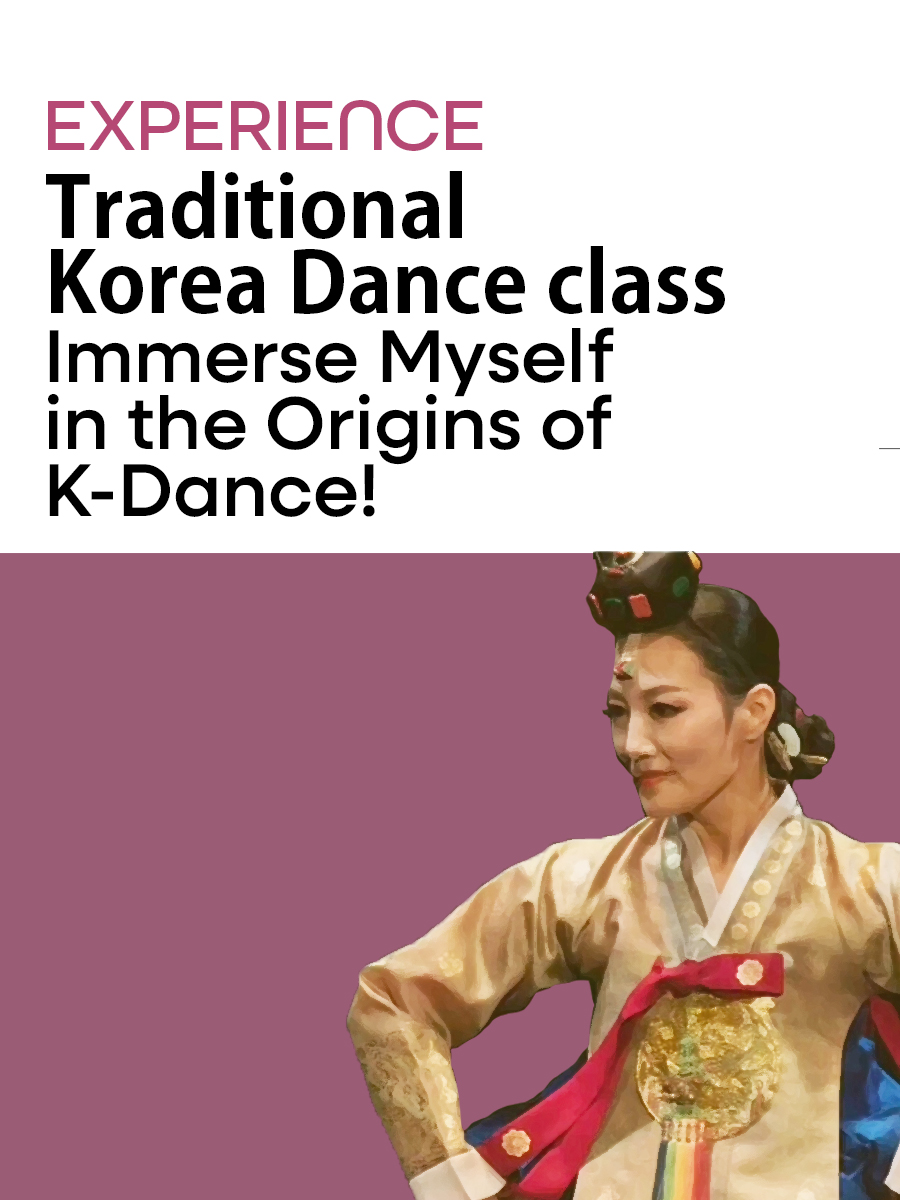
Traditional Korea Dance one day class
“Do we have any ‘Hanna’ in this class?”
She asked their one-day student if there was any “Hanna” in the class. About 10 people were in her class, most of whom had been in Korea for more than a month. I found this one-day traditional dance class on the ‘Seoul Share’ Meetup group in the Meetup app. It was interesting not only I work as a tour guide, but also because of my personal preference for Korean art. I volunteered as an interpreter at the Buddhist temple during the Jamboree, where they operated a K-pop dance experience program. I was surprised by the teacher Buddhist monk invited – she was a Traditional Korean Dancer! What impressed me even more was that she was really good at K-dance. Yes, I had prejudices.
Origin of K-dance
As I searched for information, I found that most K-pop groups assign specific roles to each member. For example, they typically consist of a Main singer, Main rapper, Main dancer, Visual, and so on. Some dancers specialize in Traditional dance at university, like Minji Gong, a member who serves as the main dancer in 2NE1. Interestingly, she is the granddaughter of Traditional Korean dancer Okjin Gong. Korean Traditional dancers have become significant members of K-pop groups. However, I believe Korean Traditional dance is quite different from Contemporary dance, so I wonder how they adjust their style to fit into the K-pop genre.
Back to the beginning, our teacher, a professional Korean Traditional dance choreographer, taught us how to count Korean rhythm. She taught us the basic rhythm cycle called Gutgeori-Jangdan, which consists of 4 quarter notes for 1 beat. Like in other dance classes, she taught the rhythm by counting numbers in Korean. Gutgeori-Jangdan was a bit slower than we thought; she counted the numbers by extending the middle sound. Instead of counting “Hana (one), Dul (two), Set (three), Net (four),” she counted “Han-na (o-one), Du-wl (Tw-oo), Se-et (Th-ree), Ne-et (fo-ur).” She made a joke about having a student named ‘Hanna’ before and she answered while counting number.
Character of Traditional Dance
I became familiar with the rhythm due to my nationality, but I faced trouble with the steps. Mostly, people place their toe on the ground first when taking a step, but for this dance, we are asked to step with the heel first for each step. This is also totally different from European dance, even traditional ones like ballet. I wondered what makes the steps different in each dance. The teacher told me that the origin of the dance was to embody nature. However, European dance developed to reach the God of the sky by wearing toe shoes, while Korean dance tried to reach the God of the earth by treading gently using the whole sole.
Each movement needs to smoothly connect with the next, with no particular movement standing out during the dance. She kept encouraging us to dance as if “floating on the waves in the ocean” or imagining our bodies as trees swaying in the wind. All the movements are inspired by nature, so we were encouraged to feel as if we had become part of nature ourselves.
Our class was scheduled for 50 minutes, but she gave more time for us for longer than that. Despite the slower pace compared to contemporary K-pop dance, it didn’t mean the dance was easier. The slow movements required a lot of energy, and by the end of the class, all of us were sweating. It seemed like almost every student wanted to learn more.
Professor YoonJeong Lee operates Korean traditional dances such as ‘Taepyeongmu’ (Great Peace Dance), ‘Salpuri’ (Korean shamanic dance), and ‘Seungmu’ (Buddhist monk dance) at her own space, ‘Art Space In, Seocho’.
Where to learn
Recently, she has been organizing classes at Yonsei University’s Future Education for 16 weeks per semester. For more details, check out her Instagram below. 🙂
https://www.instagram.com/love_kdance
EZsPEDIA © 2024 by YUNMI LEE is licensed under CC BY-NC-ND 4.0
 EZ K-PEDIA
Leave a comment