
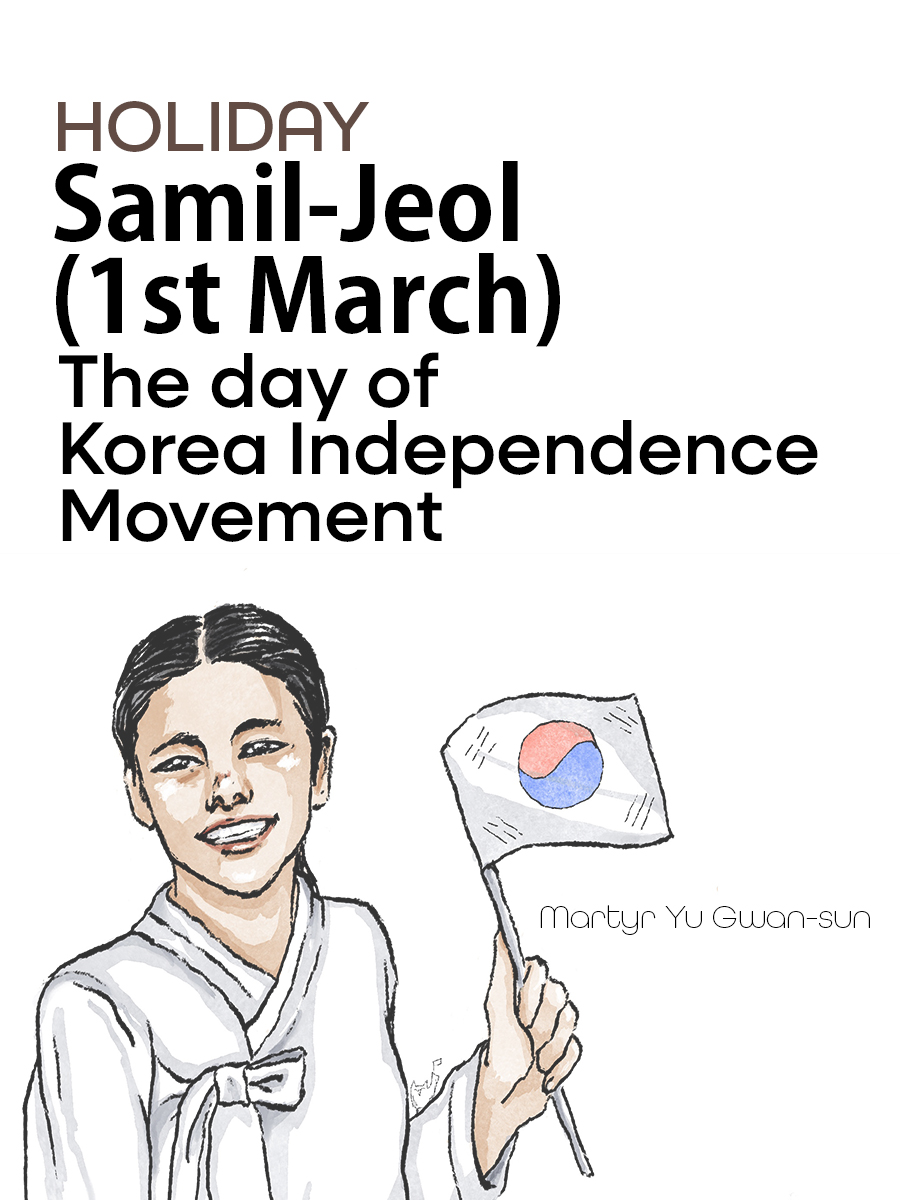
National Holidays of Korea
Are you an office worker? Thus, I’m pretty sure you’re waiting for a holiday to refresh yourself. Today is one of the national holidays appointed by the South Korean government. It’s also a national celebration day, called Samil-Jeol, which is just the pronunciation of the date in English.
History of Samil-Jeol
The Korean peninsula was occupied by the Japanese empire for 30 years, from 1910 to 1945. The first Independence movement occurred on March 1st, 1919, to protest against the harsh rule imposed by the Japanese military police without permission.

Japan thought they could rule the Korean peninsula with force and repression, but the people of Joseon didn’t share their sentiments. Furthermore, Emperor of Daehan, Gwangmu (Gojong of Joseon), died of poisoning in January. Japan wanted to suppress rumors of the Japanese empire poisoning him (although the truth was still controversial), but it had already spread among the people. The pent-up anger was ready to explode, and when the news was finally released one day later, it ignited the people.
Independence movement for all
All the people eager to achieve independence gathered together, regardless of their social class: elites, nobles, merchants, and slaves. According to studies, about 2 million people participated in this movement, which is approximately 6.31% of the population. Even students who were studying overseas returned to Korea to join it.

Result of First movement
In Tapgol Park near Insadong, Student Jaeyong Jung declared independence. It’s unclear how he obtained this declaration from representatives. People gathered at Gwanghwamun, unarmed, protesting peacefully with white cloth or the Taegeuk-gi (national flag). The movement resulted in 7,508 deaths, 15,850 injuries, and 45,306 arrests. It wasn’t as successful as hoped, with Japan emerging victorious from World War I, dissuading other countries from rebelling against them.
But the Japanese ruling system underwent changes. Japan realized that if Koreans held weapons, they could not suppress the movement. They attempted to conciliate the people but often faced resistance. This movement, led by the public, became the basis for other independence movements and the temporary Korean government.
Relevant places
The Korean government honors independence activists by assigning one each month. For those interested in Korea’s darker history, information about relevant places is provided below.

Tapgol park
Near Insa-dong, the street of antique items, lies a park frequented by Korean elders. Some play Go, others chat on benches. You might see a woman circling a pagoda secured in glass; this is where the Declaration of Independence was announced. Don’t be alarmed by trolleys adorned with pictures and the national flag; they’re expressions of patriotism. All are welcome, and everything is free.
Address:
Tapgol Park, 99 Jong-ro, Jongno-gu, Seoul

Seodaemun Prison History Hall
This memorial hall, opened in September 1998, commemorates Korea’s independence spirit and is part of the 50th anniversary of the government’s establishment. Once a modern prison, it preserves the darker chapters of Korea’s history.
Address:
Seodaemun Prison History Hall, 251 Tongil-ro, Seodaemun-gu, Seoul
Website
https://sphh.sscmc.or.kr/_eng
Operating hour
Summer season (March to October): 09:30~18:00
Winter season (November to February): 09:30~17:00
The last entrance is 30 minutes before the end of the exhibition.
Closed on
January 1st, Seollal (Lunar New Year’s Day), Chuseok (Thanksgiving Day)
Every Monday (The following day when Monday is a holiday)
* It offer docent app for free on their website.
EZsPEDIA © 2024 by YUNMI LEE is licensed under CC BY-NC-ND 4.0
 EZ K-PEDIA
Leave a comment